Field Notes: ESM-2 Model Scaling, SpatialData Zarr Stores and On-Disk Matrices
- Field Updates
- AI in Bioinformatics
- scverse
- Bioconductor
Three empirical and infrastructure developments worth building into your R and Python workflows right now:
1. Protein language model scaling: ESM-2 650M sits at the zero-shot plateau
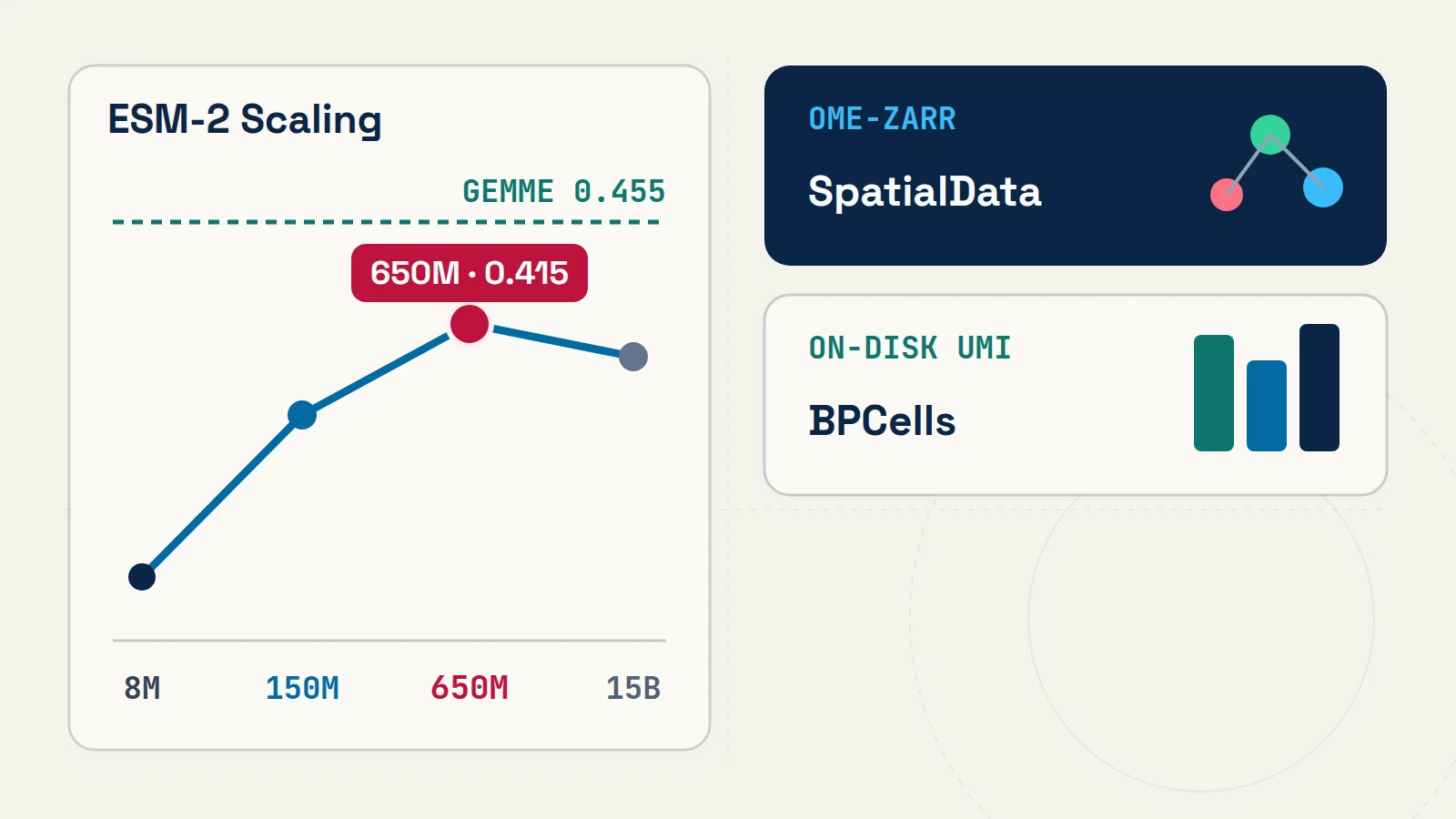
The ESM-2 protein language model family spans checkpoints from 8 million (8M) to 15 billion (15B) parameters, trained with masked-language modeling over UniRef sequences [1]. While atomic-resolution structure prediction fidelity improved up to 15B in the original ESM-2 study [1], zero-shot mutational effect prediction across deep mutational scanning (DMS) benchmarks follows a different curve.
Evaluating masked-marginal log-odds across 217 substitution assays (186 unique proteins, 2,465,767 variants) in ProteinGym v1.3 [2] shows a clear plateau:
| Model / Checkpoint | Protein-Averaged Spearman ρ (95% Bootstrap CI) | Paired Difference vs. ESM-2 650M |
Compute Footprint (217 Assays, RTX 4060 Ti 16 GB) |
|---|---|---|---|
ESM-2 8M |
0.223 [0.186, 0.262] |
— | < 5 min |
ESM-2 150M |
0.388 [0.348, 0.425] |
−0.034 (below 650M) |
~10 min |
ESM-2 650M |
0.415 [0.376, 0.452] |
Reference plateau | 26 min · 2.3 GB peak VRAM |
ESM-2 3B |
0.407 [0.370, 0.443] |
−0.0027 [−0.0135, +0.0088] (not distinguishable) |
82 min · 6.6 GB peak VRAM |
ESM-2 15B (published) |
0.400 [0.368, 0.433] |
−0.0087 [−0.0241, +0.0073] (not distinguishable) |
Multi-GPU / high-VRAM server |
GEMME (alignment epistatic) |
0.455 [0.426, 0.484] |
+0.0444 [+0.0206, +0.0695] (ahead overall) |
CPU alignment + fast epistatic fit [3] |
Stratifying the 186 proteins by multiple sequence alignment (MSA) effective depth (Neff / L) clarifies where larger checkpoints lose ground [2]: on the 63 high-depth protein families (Neff / L > 100), ESM-2 3B scores lower than 650M by a paired mean difference of −0.0283 [−0.0423, −0.0149], while on the deepest slice GEMME and ESM-2 650M are not distinguishable (−0.0200 [−0.0448, +0.0065]). Practically: start with ESM-2 650M, run GEMME whenever a reliable alignment exists [3], and spend saved compute on experimental validation.
2. One versioned Zarr container for spatial omics: SpatialData
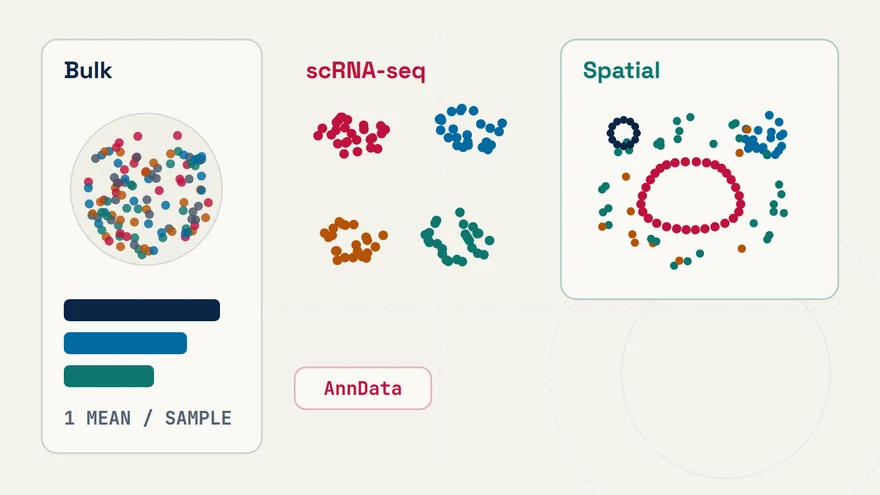
Across Xenium, CosMx, and Visium HD studies, storing multi-scale pathology images as TIFFs, cell boundaries as GeoJSON, and counts as separate .h5ad files frequently introduces micron-scale coordinate-system drift during cropping or registration. SpatialData stores raster images, vector segmentation shapes, transcript point clouds, and AnnData expression tables together inside a single OME-NGFF Zarr store with explicit coordinate transformations [4].
3. On-disk count matrices and audited single-cell embeddings
Bit-packed on-disk matrices in BPCells (Seurat v5 in R) [5] and chunked Zarr / HDF5 backing in AnnData (Python) allow million-cell reference atlases to be filtered, projected, and aggregated into donor pseudobulk tables on a laptop or standard workstation without loading dense matrices into RAM. Similarly, while pretrained single-cell models such as scGPT [6] now integrate into AnnData pipelines for reference mapping, independent zero-shot evaluations emphasize benchmarking pretrained embeddings against PCA / scVI on your own cohort rather than assuming zero-shot superiority [7].
References & primary sources
- (2023). Evolutionary-scale prediction of atomic-level protein structure with a language model. Science 379(6637), 1123–1130. DOI: 10.1126/science.ade2574
- (2023). ProteinGym: Large-Scale Benchmarks for Protein Fitness Prediction and Design. Advances in Neural Information Processing Systems 36, 64331–64379. DOI: 10.52202/075280-2810
- (2019). GEMME: A Simple and Fast Global Epistatic Model Predicting Mutational Effects. Molecular Biology and Evolution 36(11), 2604–2619. DOI: 10.1093/molbev/msz179
- (2024). SpatialData: an open and universal data framework for spatial omics. Nature Methods 21, 589–592. DOI: 10.1038/s41592-024-02212-x
- (2024). Dictionary learning for integrative, multimodal and scalable single-cell analysis. Nature Biotechnology 42, 293–304. DOI: 10.1038/s41587-023-01767-y
- (2024). scGPT: toward building a foundation model for single-cell multi-omics using generative AI. Nature Methods 21, 1470–1480. DOI: 10.1038/s41592-024-02201-0
- (2025). Zero-shot evaluation reveals limitations of single-cell foundation models. Genome Biology 26, 101. DOI: 10.1186/s13059-025-03574-x
CodingGenes (2026). Field Notes: ESM-2 Model Scaling, SpatialData Zarr Stores and On-Disk Matrices. CodingGenes. https://codinggenes.com/blog/scverse-bioconductor-release-roundup/
Common questions
Which ESM-2 checkpoint should I start with for zero-shot missense variant scoring?
Start with ESM-2 650M (esm2_t33_650M_UR50D). Across 217 ProteinGym substitution assays (186 proteins), 650M reaches a protein-averaged Spearman correlation of 0.415 in 26 GPU-minutes with 2.3 GB peak memory on one 16 GB GPU, whereas 3B (0.407) and 15B (0.400) are not statistically distinguishable overall.
Should I still run a multiple-sequence alignment baseline alongside a protein language model?
Yes. Whenever homologs are available to build a multiple sequence alignment, compare language-model masked marginals against an evolutionary epistatic model such as GEMME, which averages 0.455 across the same ProteinGym benchmark with no deep-learning GPU requirement.
Continue learning with CodingGenes
Receive an email whenever a new topic, benchmark note, or YouTube lesson is published.