Why Now Is the Best Time to Learn Bioinformatics
- Bioinformatics Concepts
- AI in Bioinformatics
- R & Python
- Foundation Models
For much of the past two decades, entering bioinformatics required months of troubleshooting compilation toolchains, incompatible file formats, and ad hoc parser scripts before running a single statistical test. That barrier obscured what computational biology actually does: connecting molecular measurements to testable biological models.
Two shifts have changed how scientists learn and practice the field. First, mature open-source ecosystems—Bioconductor and Seurat v5 in R [1, 3], and scverse (AnnData, Scanpy, SpatialData) in Python [2, 4]—have standardized how expression matrices, sample covariates, and tissue coordinates are stored in memory and on disk. Second, general-purpose large language models (LLMs) such as ChatGPT and Gemini, together with procedural research-agent workflows [7], have compressed the time required to write routine data-wrangling and plotting code.
When syntax becomes faster to produce, scientific judgment becomes the limiting step. Three capabilities now separate reliable bioinformatics analyses from plausible-looking errors.
1. Understand the measurement model underneath the container
Every omics workflow rests on a small set of physical and statistical questions:
- What physical event produced one count? In short-read bulk RNA sequencing (
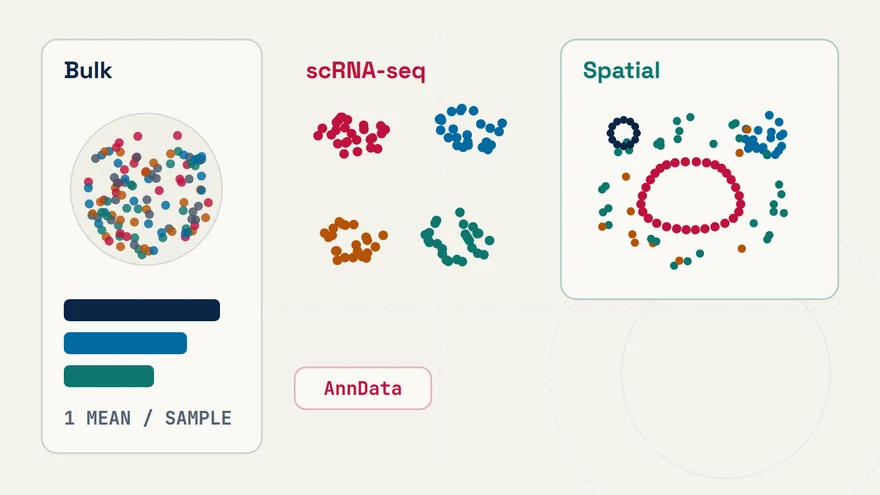
RNA-seq), read counts reflect fragment abundance pooled across millions of cells; in droplet single-cell RNA-seq (scRNA-seq), unique molecular identifiers (UMIs) tag transcripts captured from individual cells or nuclei; in targeted spatial assays, optical decoding records(x, y, z)coordinates of hybridized probes inside fixed tissue [4]. - Where do countmatrix, sample metadata, and feature metadata live? Whether you open a
SummarizedExperimentin R or anAnnDataobject in Python [1, 2], the core architecture is identical: an integer count matrix linked to observation-level covariates (colDataor.obs) and gene-level annotations (rowDataor.var). - Which source of variance is biological versus technical? Library depth, capture efficiency, batch processing, and donor-to-donor variability shape count dispersion before any treatment effect is estimated.
Once those relationships are clear, moving between R and Python—or asking an LLM to translate an analysis from Seurat v5 to Scanpy—becomes a transparent mapping between equivalent slots rather than guesswork.
2. Harness LLMs for implementation while owning the study design
In day-to-day bioinformatics, LLMs are most effective when treated as fast implementation partners under explicit statistical constraints:
| Workflow Stage | High-Value Use of ChatGPT / Gemini | Verification Owned by the Researcher |
|---|---|---|
| Data ingestion & QC | Writing reproducible AnnData / Seurat loaders, metadata joins, and multi-panel diagnostic figures |
Confirming raw integer UMIs are preserved separately from log-normalized views |
| Hypothesis testing | Drafting DESeq2 or PyDESeq2 design formulas and contrast tables |
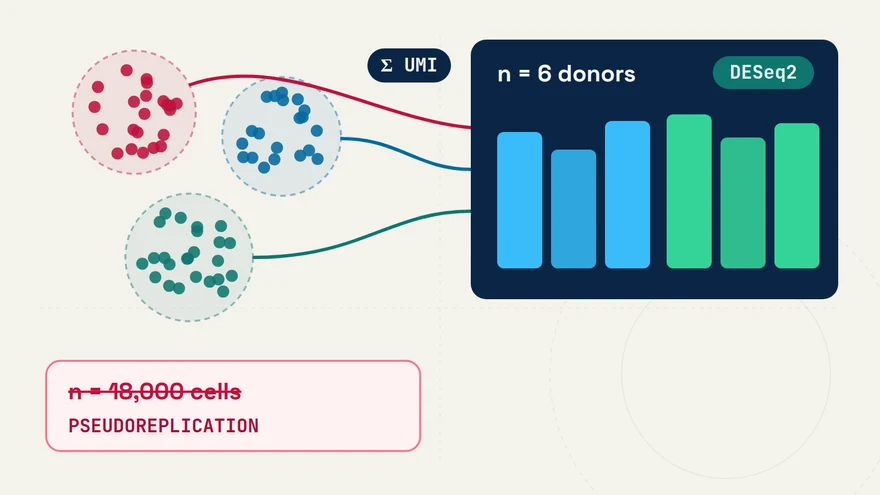
Ensuring the statistical unit (n) matches the randomized donor, animal, or well rather than pooled cells |
| Foundation-model inference | Scaffolding embedding extraction with ESM-2, scGPT, or AlphaFold 3 [5] |
Benchmarking zero-shot predictions against sequence-alignment or linear baselines [6] |
A language model inspecting adata.obs cannot tell on its own whether six samples represent six independent patients or six technical aliquots from a single biopsy. Supplying the experimental hierarchy in your prompt—and checking the degrees of freedom reported by the fitted model—prevents pseudoreplication and unmodeled batch confounding.
3. Evaluate biological foundation models with the same rigor as classical algorithms
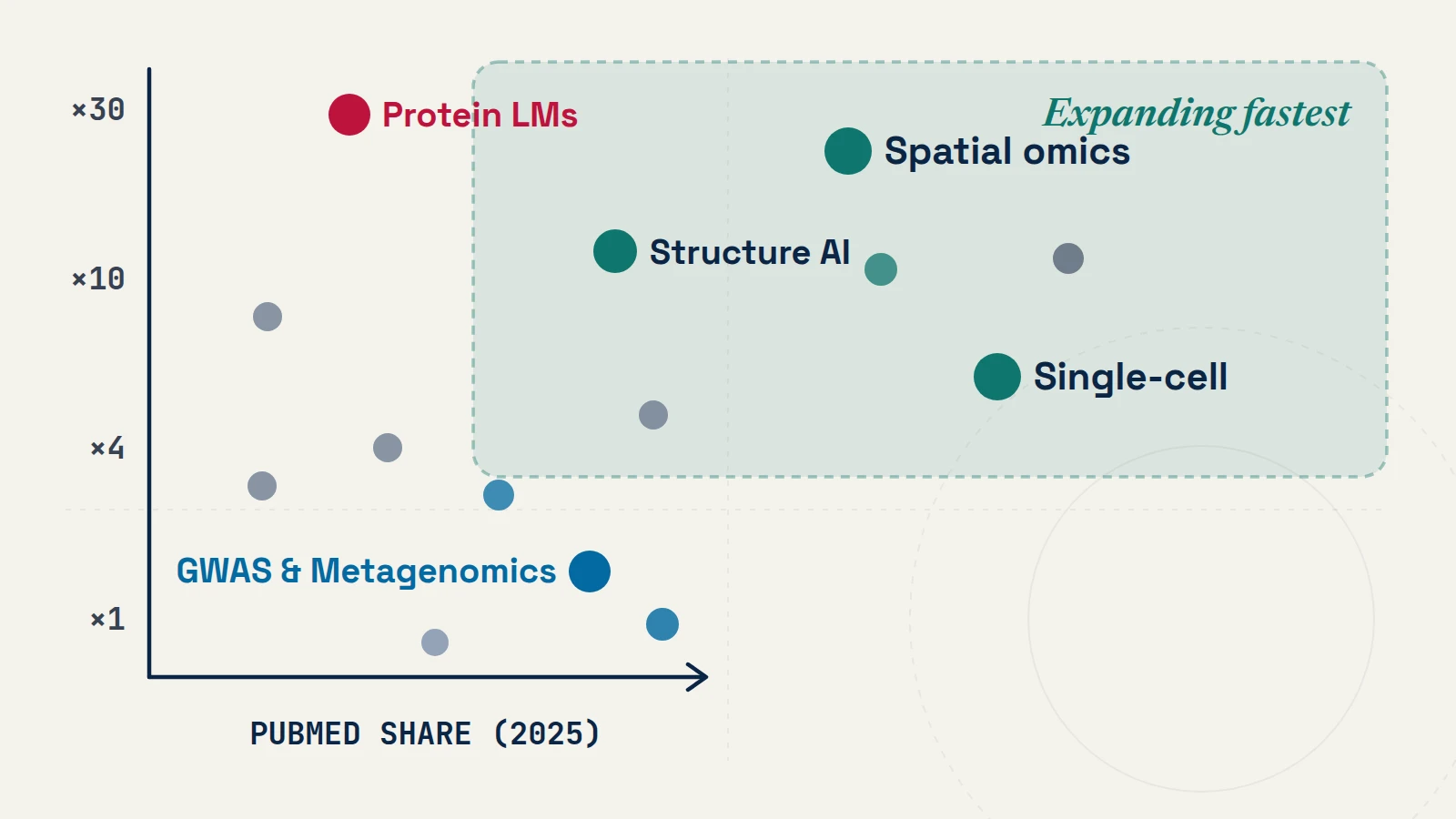
Pretrained biological models have expanded what a single laboratory can compute, from biomolecular complex prediction with AlphaFold 3 [5] to protein sequence representations and single-cell embeddings [3, 6]. At the same time, independent zero-shot evaluations show that larger or more complex models do not automatically outperform simpler methods across every task; for example, zero-shot single-cell foundation models can trail established integration or feature-selection baselines when evaluated without task-specific fine-tuning [6].
Scope and limitations
Standardized containers and AI assistants reduce software friction, but they cannot rescue an underpowered cohort, unrecorded batch confounding, or degraded RNA in archival tissue. At CodingGenes, our guides, YouTube lessons, and structured learning tracks focus on that intersection: clear visual models of how assays and algorithms work, side-by-side R and Python implementations, and explicit verification checks for working in the AI era.
References & primary sources
- (2015). Orchestrating high-throughput genomic analysis with Bioconductor. Nature Methods 12, 115–121. DOI: 10.1038/nmeth.3252
- (2023). The scverse project provides a computational ecosystem for single-cell omics data analysis. Nature Biotechnology 41, 604–606. DOI: 10.1038/s41587-023-01733-8
- (2024). Dictionary learning for integrative, multimodal and scalable single-cell analysis. Nature Biotechnology 42, 293–304. DOI: 10.1038/s41587-023-01767-y
- (2024). SpatialData: an open and universal data framework for spatial omics. Nature Methods 21, 589–592. DOI: 10.1038/s41592-024-02212-x
- (2024). Accurate structure prediction of biomolecular interactions with AlphaFold 3. Nature 630, 493–500. DOI: 10.1038/s41586-024-07487-w
- (2025). Zero-shot evaluation reveals limitations of single-cell foundation models. Genome Biology 26, 101. DOI: 10.1186/s13059-025-03574-x
- (2026). Scientific Agent Skills: A Library of Procedural Knowledge for Research Agents. arXiv:2609.00065. DOI: 10.48550/arXiv.2609.00065
CodingGenes (2026). Why Now Is the Best Time to Learn Bioinformatics. CodingGenes. https://codinggenes.com/blog/why-now-is-the-best-time-to-learn-bioinformatics/
Common questions
What is the most effective way to start learning bioinformatics in the AI era?
Begin with the physical measurement and core data container—how sequencing reads or imaging probes become integer counts in SummarizedExperiment, Seurat, AnnData, or SpatialData—and learn experimental replication alongside R and Python scripting. Use ChatGPT or Gemini to explain syntax and draft plots, but verify sample sizes, normalization layers, and model designs yourself.
How are AI tools used in modern computational biology workflows?
AI enters at two distinct layers. General-purpose large language models and procedural coding agents speed up pipeline authoring across Bioconductor, scverse, and Nextflow. Domain-specific biological models—such as AlphaFold 3 for biomolecular complexes, ESM-2 for protein sequences, and scGPT for single-cell expression—provide learned representations that still require task-specific benchmarking.
Should a biologist learn R or Python first?
Either language is a productive starting point when anchored in shared statistical concepts. R (Bioconductor, DESeq2, Seurat v5) remains central for generalized linear modeling and clinical cohort inference, while Python (scverse, Scanpy, PyDESeq2, SpatialData) connects directly to modern machine learning and spatial Zarr stores.
Continue learning with CodingGenes
Receive an email whenever a new topic, benchmark note, or YouTube lesson is published.